
Article: Automatic Watches vs. Quartz – What's the Difference? | Argo

Automatic Watches vs. Quartz – What's the Difference? | Argo
Automatic watch vs. quartz – what's the difference?
When you're choosing a watch, the movement is one of the most important factors to consider. Two of the most common alternatives are automatic and quartz, also called quartz movement.
Both have the same basic job: keeping time. The way they do it is, however, very different.
A quartz watch is usually more accurate and requires very little maintenance. An automatic watch is made up of a number of mechanical components that work together and get their energy from movement.
One isn't necessarily better than the other. The choice largely depends on what you want from your watch.
What is an automatic watch?
An automatic watch is a mechanical watch that winds itself using the movements of your wrist.
Inside the movement is a moving weight called a rotor. When you move your arm, it rotates and winds the mainspring in the movement. Energy is stored in the spring and gradually released through the movement's gear train, going train and balance wheel.
This means an automatic watch doesn't need a regular battery to run.
As long as the watch is worn regularly and gets enough movement, it will usually keep running. If you take it off for an extended period, the power reserve will eventually run out and the watch will stop. It will then need to be wound or set moving again.
Why do many people choose an automatic watch?
For many watch enthusiasts, automatic watches are about more than just telling the time.
A mechanical movement can consist of a large number of small components working together. The Federation of the Swiss Watch Industry describes a standard mechanical movement as a system where energy from the mainspring is transferred through the gear train, while the escapement and balance wheel regulate time.
It is this mechanics that makes automatic watches interesting to many people.
You get a small mechanical system on your wrist that works continuously without a traditional battery.
Automatic movements are therefore often associated with:
-
mechanical craftsmanship
-
traditional watchmaking artistry
-
complex constructions
-
visible movements and moving components
-
the feeling of owning something mechanical rather than electronic
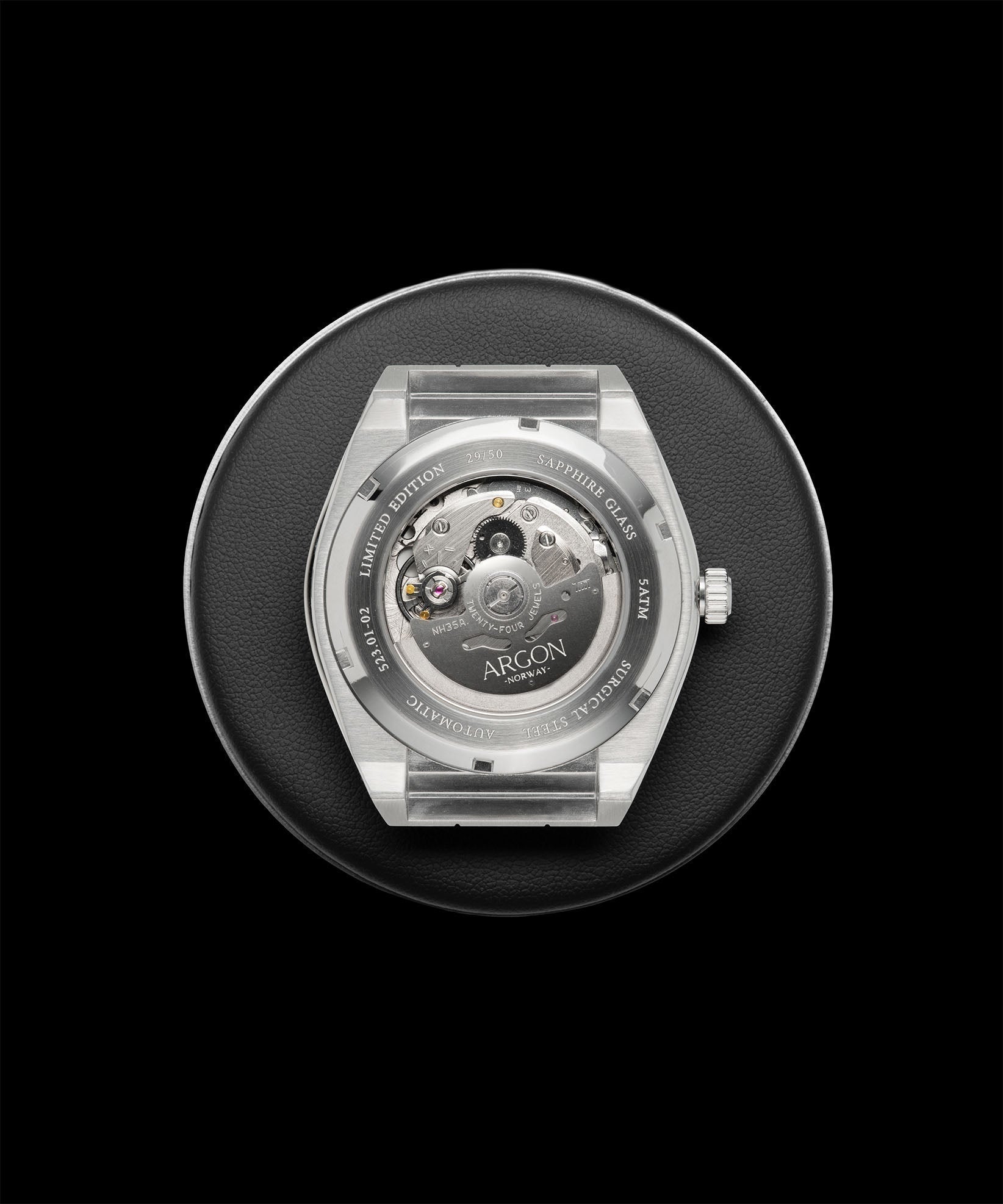
On some watches, the movement can also be seen through a transparent case back.
What is a quartz watch?
A quartz watch works electronically.
A battery sends electrical energy through a small quartz crystal inside the movement. When the quartz crystal receives an electrical voltage, it vibrates at a very stable frequency.
These vibrations are used as a reference for measuring time.
The watch's electronics count the vibrations and send signals to a small motor that moves the hands.
This is partly why the seconds hand on many traditional quartz watches moves in one clear step per second.
Why is quartz more accurate?
The big advantage of quartz is precision.
A typical quartz crystal in a wristwatch vibrates at a very high and stable frequency. The Federation of the Swiss Watch Industry states 32 kHz as a standard frequency and describes typical quartz watches as very precise, with deviations of less than one second per day.
Mechanical watches are far more affected by their surroundings.
Temperature, shocks, the position the watch is in, how much the mainspring is wound, and how the watch is used can all affect the accuracy of a mechanical movement.
That is why the accuracy of mechanical watches is often given as a daily deviation, while quartz watches are typically evaluated over longer periods.
Automatic vs. quartz: the key differences
| Automatic | Quartz | |
|---|---|---|
| Power source | Mechanical spring | Battery / electrical energy |
| Winding | Movement from the wrist and/or manual winding | Not required |
| Accuracy | Usually lower | Usually higher |
| Battery replacement | No | Usually yes |
| Mechanical complexity | High | Lower |
| Maintenance | More | Little |
| Seconds hand | Often multiple small movements per second | Often one step per second |
| Can stop when not in use | Yes | Usually not |
| Appell | Mechanics and craftsmanship | Precision and simplicity |
Is an automatic watch better than quartz?
Not necessarily.
It all depends on what you value.
If your primary goal is to have a watch that keeps time as accurately as possible and requires minimal attention, quartz is an excellent choice.
If you put the watch on after it has been in a drawer for several weeks, it will usually still show the correct time.
An automatic watch offers something different.
Here, the mechanics themselves are part of the product. The rotor moves when you move your wrist, the mainspring stores energy, and a number of small mechanical parts ensure the hands continue to move.
It won't necessarily be as accurate as a quartz watch.
For many people, that is exactly the point.
How long can an automatic watch run without being worn?
This is determined by the watch's power reserve, also called power reserve.
The power reserve describes how long the movement will continue to run after the mainspring is fully wound.
When this energy is used up, the watch stops.
How long a watch's power reserve lasts varies between different movements. When you start wearing the watch again, it can be wound and the time reset.
Does an automatic watch need servicing?
Yes.
A mechanical movement is made up of moving parts that need proper lubrication and adjustment. Over time, oils can dry out or change their properties, and the components may need cleaning and inspection.
How often servicing is needed depends on the movement, the watch, how it is used, and the manufacturer's recommendations.
Quartz movements generally require less mechanical maintenance, but a traditional battery-powered quartz watch will typically need a new battery after a few years.
Which type of watch should you choose?
Choose quartz if your top priorities are:
-
high precision
-
low maintenance
-
a watch that can sit unworn for a long time
-
simple, reliable operation
Choose automatic if your top priorities are:
-
a mechanical movement
-
traditional watchmaking craft
-
a greater interest in how the watch works
-
a watch where the mechanics are part of the experience
For many people, the choice ultimately matters less about specifications and more about the relationship they want to have with their watch.
Quartz watches are designed to tell time with extremely high precision.
An automatic watch does the same job using springs, gears, and mechanical movements.
Two different solutions to the same problem – and two very different ways to experience a watch.
Frequently asked questions
Does an automatic watch have a battery?
No. A traditional automatic mechanical movement is powered by energy stored in a mainspring. The rotor inside the watch helps wind this spring when the watch is moved.
Is quartz more accurate than automatic?
As a general rule, yes. Quartz movements use the stable vibration of a quartz crystal as a time reference and are typically significantly more accurate than traditional mechanical movements.
Do you have to wind an automatic watch?
If the watch is worn regularly, movements from the wrist will usually keep the mainspring wound. If the watch has stopped after sitting unworn, it may need to be wound and the time reset.
Why are automatic watches popular when quartz is more accurate?
Because precision is not the only feature people value in a watch. Automatic watches offer mechanics, tradition, and a complex movement that works without a regular battery. For many people, this is an important part of the experience of owning a mechanical watch.